
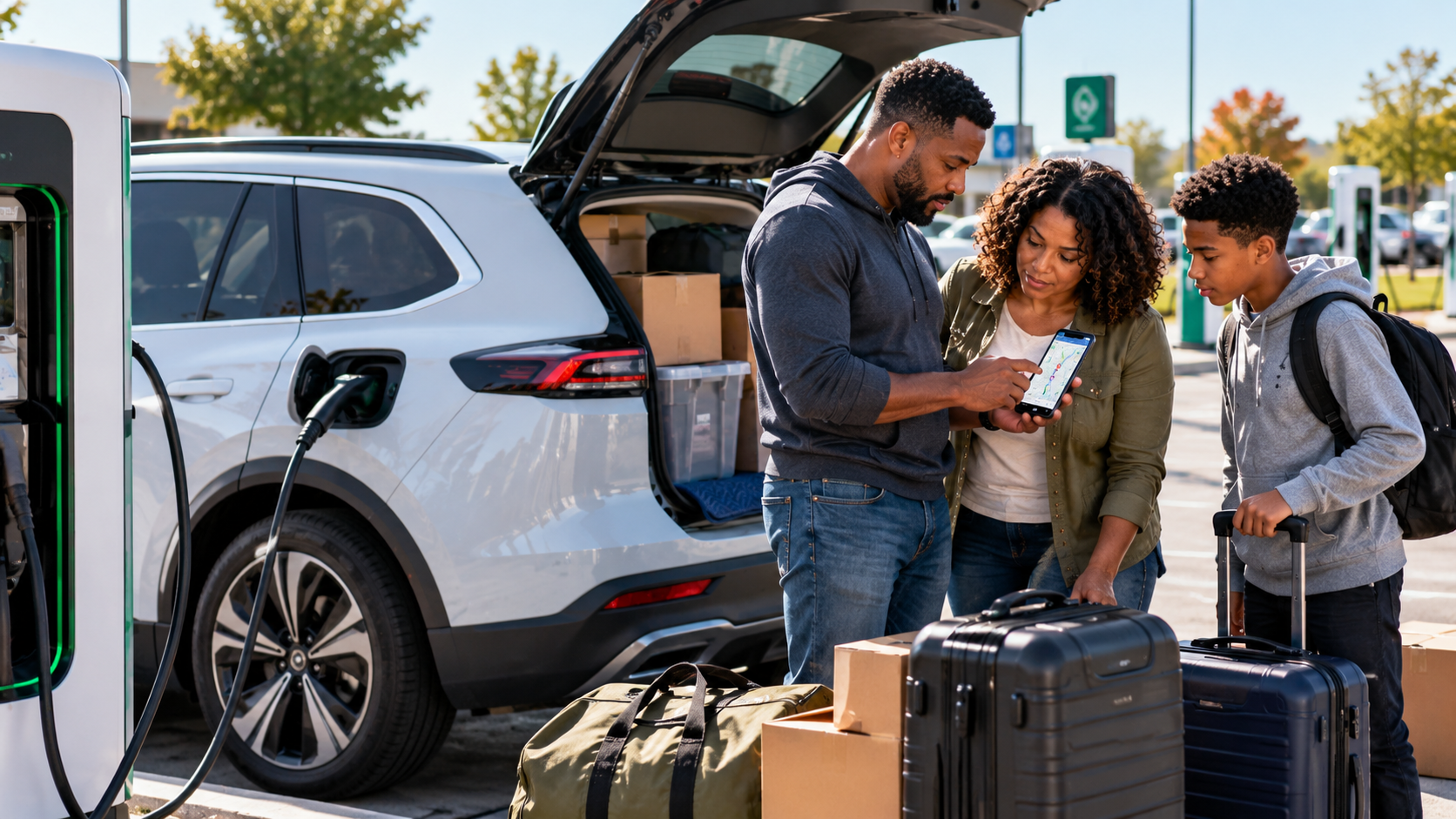
Relocating with an electric vehicle can add a few extra questions to an already complicated move.
Can you make the entire trip using your normal charging network? Will your new home have a place to charge? What happens if your apartment doesn’t offer EV charging? Should you drive the vehicle or have it transported? And could your charging costs change after you move?
For a local move, these questions may be relatively simple.
For a long-distance relocation, especially one that crosses several states; planning ahead can make the difference between an ordinary road trip and spending moving day searching for a compatible charger with a nearly empty battery.
The good news is that relocating with an EV doesn’t have to be difficult.
You simply need to plan for the vehicle as part of the relocation rather than assuming you’ll figure out charging after everything else is scheduled.
If you haven’t connected with a local real estate agent yet, this is usually the stage where many movers find it helpful to do so.
Decide Whether You’ll Drive or Transport Your EV
Start with the same question you would ask about any vehicle during a long-distance relocation:
Does it make sense to drive it?
Driving may be practical when:
- Your route has reliable charging infrastructure.
- You have enough time for charging stops.
- The distance is manageable.
- You already understand your vehicle’s real-world range.
- You’re comfortable navigating unfamiliar charging networks.
Professional vehicle transportation may make more sense when you’re traveling a very long distance, have multiple vehicles, are flying to your destination, or don’t want the EV road trip to complicate your moving schedule.
If your household has several vehicles, this decision should be part of your overall vehicle-relocation plan.
Don’t Plan Your Trip Around Maximum Advertised Range
The range displayed when your vehicle is fully charged isn’t necessarily the distance you should expect between every charging stop.
Real-world range can change because of:
- Highway speeds
- Temperature
- Elevation
- Wind
- Heating and air-conditioning use
- Cargo weight
- Driving habits
- Battery condition
A vehicle packed with belongings and traveling at highway speeds through unfamiliar terrain may perform differently than it does during your normal commute.
Build a buffer into your route.
Arriving at a charger with some remaining range gives you options if the charger is occupied, unavailable, or unexpectedly out of service.
Map Charging Stops Before Moving Day
Don’t wait until your battery is low to begin searching for a charger.
Before leaving, identify potential charging locations along the route.
The U.S. Department of Energy’s Alternative Fuels Data Center provides a station locator that can help drivers find electric-vehicle charging stations across the country.
U.S. Department of Energy — Alternative Fueling Station Locator
When planning your route, look beyond simply whether a charger exists.
Consider:
- Charger speed
- Connector compatibility
- Number of charging stalls
- Nearby backup locations
- Operating hours when applicable
- Amenities while you’re charging
Having a primary charger and a backup option can prevent one unavailable station from disrupting your schedule.
Remember That Charging Adds Time to Your Relocation
A gasoline stop might take only a few minutes.
An EV charging stop may take considerably longer depending on the vehicle, charger, battery level, and charging speed.
That matters when you’re trying to coordinate:
- Movers
- Hotel reservations
- Closing or lease appointments
- Key pickup
- Utility appointments
- Family travel
- Vehicle deliveries
Don’t create a moving-day schedule that assumes you’ll arrive at the exact time predicted by a navigation app.
Give yourself some flexibility.
Your overall relocation timeline should account for transportation realities rather than treating travel time as a perfect number.
Plan Overnight Stops Around Charging Too
If the trip requires hotels, charging becomes part of your overnight strategy.
A hotel with compatible charging can potentially allow you to begin the next morning with substantially more range.
But don’t assume that seeing “EV charging” listed as an amenity guarantees you’ll be able to use it.
Before relying on hotel charging, consider confirming:
- What type of charger is available
- How many chargers are available
- Whether they’re restricted to guests
- Whether reservations are possible
- Whether there’s an additional fee
- Whether another charging station is nearby
One charger serving an entire hotel is very different from a location with several charging spaces.
Understand Your Charging Compatibility
EV charging infrastructure continues to evolve.
Your vehicle may use a particular connector native to your vehicle or requires an adapter to access certain charging networks.
Before relocating, make sure you understand:
- Which connectors your vehicle supports
- Which adapters you already own
- Which charging networks are available along your route
- Whether accounts or apps need to be established in advance
Download necessary apps and create accounts before the trip.
Doing that from your driveway is easier than trying to establish an account at night in an unfamiliar parking lot with a low battery.
Don’t Assume Your New Home Is Ready for an EV
Getting the vehicle to your destination is only half of the problem.
You also need somewhere to charge after you arrive.
If you’re buying a home, determine what charging options already exist.
Look for:
- Existing EV charging equipment
- Appropriate electrical service
- Garage or driveway access
- Distance between parking and electrical equipment
- HOA restrictions when applicable
If a charger needs to be installed, the electrical work may need to be completed by a qualified professional.
Don’t assume an ordinary household outlet will automatically meet your long-term charging needs.
Ask About Charging Before Signing an Apartment Lease
EV charging deserves additional attention when you’re renting.
Before signing a lease, ask:
- Does the property have EV chargers?
- How many?
- Who can use them?
- What do they cost?
- Are they assigned or first-come, first-served?
- Can residents install charging equipment?
- Are there nearby public chargers?
A property having two charging spaces doesn’t necessarily mean charging will be convenient if hundreds of residents share them.
If EV ownership is central to your transportation, charging access should be part of how you evaluate the property—not something you investigate after moving in.
Research Your New Utility Company
Your electricity provider may change when you relocate.
That means your cost to charge at home can change too.
Some utilities offer:
- Time-of-use electricity rates
- EV-specific programs
- Off-peak charging incentives
- Charger rebates
- Installation incentives
Rates and programs vary by location.
Once you know where you’re moving, research the utility serving the new property and determine whether charging during certain hours could reduce your costs.
If you’re already coordinating utilities for the move, handle this research at the same time.
Research Incentives at Your Destination
Changing states can also change the incentives, fees, taxes, and programs associated with EV ownership.
Depending on where you move, there may be differences involving:
- Vehicle registration fees
- State or local incentives
- Charging-equipment incentives
- Utility rebates
- Inspection requirements
- Taxes
Don’t assume the rules from your previous state follow you.
This connects directly with the broader administrative work involved when crossing state lines.
If You’re Shipping the EV, Ask EV-Specific Questions
If you decide not to drive the vehicle, tell the transportation company that it is electric before booking.
Ask about:
- Experience transporting EVs
- Battery state-of-charge requirements
- Alarm or security settings
- Keys and access
- Vehicle condition documentation
- Personal belongings inside the vehicle
- Pickup and delivery procedures
- Insurance and liability
Follow the carrier’s instructions and your vehicle manufacturer’s recommendations rather than assuming the preparation process is identical to a gasoline vehicle.
Take photographs of the vehicle before transportation and document its condition.
Don’t Turn Your EV Into a Moving Truck Without Thinking About Range
It can be tempting to fill every available inch of your vehicle with belongings.
But additional weight can affect efficiency.
You also don’t want boxes blocking visibility, interfering with access to charging equipment, or creating unsecured objects inside the passenger compartment.
Keep charging cables, adapters, and anything you may need during the trip easily accessible.
They shouldn’t be buried underneath everything you own.
Have a Backup Charging Plan
Even a carefully planned route can change.
A charger might be:
- Occupied
- Out of service
- Inaccessible
- Slower than expected
Construction, weather, traffic, or an unexpected detour can also change how much energy you use.
For major charging stops, identify at least one alternative.
You don’t necessarily need a complicated emergency plan for every mile of the trip.
You simply don’t want your entire relocation depending on one charger working exactly as expected.
Include EV Expenses in Your Relocation Budget
EV relocation expenses can extend beyond electricity.
You might encounter:
- Public charging fees
- Hotel costs
- Vehicle transportation
- Charging-equipment installation
- Electrical upgrades
- Adapters
- Registration costs
- New state EV fees
Include these expenses in your relocation budget before the move.
A few hundred dollars of unexpected vehicle expenses may not destroy a relocation budget, but they’re much easier to manage when you’ve anticipated them.
Final Thoughts
An electric vehicle doesn’t make relocation dramatically more complicated.
It does make certain details more important.
Know whether you’re driving or shipping the vehicle. Map charging before leaving. Give yourself enough range and time for unexpected problems. Understand what charging will look like at your new home, and research how your new state and utility treat EV ownership.
Most importantly, don’t wait until moving day to answer those questions.
Your EV is part of your relocation plan just like your household belongings, housing, utilities, and other vehicles.
Plan for it early, and the trip becomes much easier.
If you haven’t spoken with a local agent yet, this can be a helpful time to connect with someone familiar with the area you’re considering.