
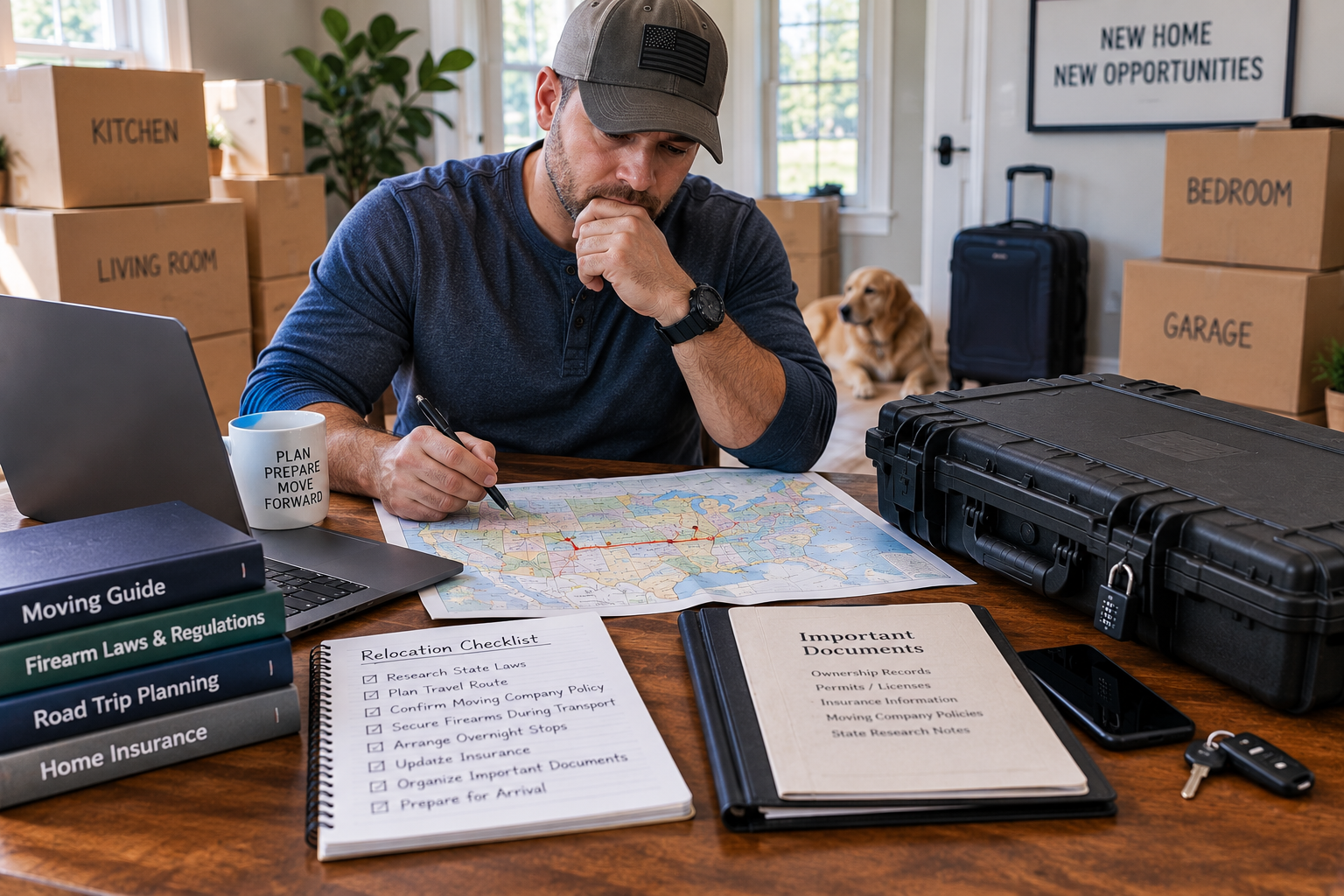
Moving to another city or state requires careful planning for everything you own, but firearms deserve additional attention.
Unlike ordinary household belongings, firearms may be subject to federal, state, and local laws that affect how they can be transported, stored, transferred, and possessed. A move that takes you across several state lines can also mean traveling through jurisdictions with different requirements.
If firearms are part of your household, don’t wait until moving day to decide how you’ll transport them.
Researching the rules ahead of time, creating an inventory, and developing a secure transportation plan can help you prepare for the move while avoiding unnecessary surprises.
If you haven’t connected with a local real estate agent yet, this is usually the stage where many movers find it helpful to do so.
Start With an Inventory of Your Firearms
Before packing for the move, document what you own.
Your inventory might include:
- Handguns
- Rifles
- Shotguns
- Collectible firearms
- Ammunition
- Related accessories
Keep identifying information and ownership records secure rather than placing sensitive information on the outside of a box or container.
An inventory can also help with insurance documentation and make it easier to determine whether any particular firearm requires additional research before the move.
Research the Laws Before Crossing State Lines
Moving from one state to another can introduce an entirely different set of firearm laws.
Before traveling, research the laws in:
- Your current state
- Your destination state
- States you’ll travel through
- Local jurisdictions when applicable
Requirements can involve possession, transportation, storage, permits, magazines, ammunition, and particular types or configurations of firearms.
Don’t assume that something legal where you currently live will automatically be treated the same way everywhere along your route.
This is part of the broader research that should happen whenever you’re moving into a state with different laws.
Understand Federal Protections and Their Limitations
Federal law provides certain protections for lawful interstate transportation of firearms under qualifying circumstances, but those protections have conditions and should not be treated as a blanket exemption from every state or local firearm law.
Your specific route and circumstances matter.
Before traveling, use current information from authoritative government sources and seek qualified legal guidance when you’re uncertain about how a law applies to your situation.
Avoid relying solely on social media posts, discussion forums, or information written years ago.
Don’t Assume Your Moving Company Will Transport Firearms
If you’re hiring professional movers, ask about their firearm and ammunition policies before moving day.
Companies may have restrictions on items they’re willing or permitted to transport, and ammunition may be treated differently from the firearm itself.
Never hide a prohibited item inside ordinary household goods to avoid a company’s policy.
Instead, determine how each restricted item will be handled while you’re still developing your moving plan.
Develop a Secure Transportation Plan
If you’re personally transporting firearms, security should be part of your planning.
Research the requirements that apply to your trip and consider how you’ll prevent unauthorized access throughout the journey.
Your plan should account for situations such as:
- Overnight hotel stays
- Meal and fuel stops
- Vehicle breakdowns
- Changing vehicles
- Unexpected route changes
- Arriving before your household goods
The objective is to know how your firearms will remain secured throughout the entire relocation rather than deciding what to do at each stop.
Think Carefully About Overnight Stops
A one-day drive may become a multi-day relocation when you’re traveling hundreds or thousands of miles.
That introduces another question:
What happens to the firearms when you stop overnight?
Research applicable laws before the trip and develop a plan that accounts for lodging, vehicle security, and unauthorized access.
Don’t assume the rules that applied while you were driving are necessarily the only rules relevant once you stop.
Keep Important Documentation Organized
Moving already involves a considerable amount of paperwork, and firearm owners may have additional records they want or need to keep accessible.
Depending on your circumstances, those could include:
- Ownership records
- Applicable permits or licenses
- Insurance information
- Relevant legal information
- Contact information for appropriate authorities or professionals
Store sensitive documentation securely.
Your broader relocation documents should also remain organized and accessible throughout the move.
Review Your Insurance Coverage
Moving is also a good time to determine whether your insurance appropriately covers your firearms.
Standard homeowners or renters policies may have limits or special provisions involving firearms or valuable collections.
Ask your insurer about:
- Coverage limits
- Documentation requirements
- Transportation-related coverage
- High-value items
- Whether additional coverage is appropriate
Don’t assume every loss or damage scenario is automatically covered.
Research the Rules at Your New Home
The transportation portion of the move eventually ends, but your responsibilities don’t necessarily end when you arrive.
Your destination may have different requirements involving:
- Possession
- Storage
- Permits or licenses
- Registration where applicable
- Local ordinances
- Other restrictions
Research those requirements before arrival so you aren’t trying to understand them while simultaneously unpacking your home.
If you’re moving into an apartment, condominium, or other managed property, you should also understand any lawful provisions in your lease or governing documents that may affect you.
Consider Children and Other Household Members
A relocation can temporarily disrupt the routines and organization you normally have at home.
Boxes are everywhere. Doors may be open. Friends, relatives, movers, contractors, or other people may be coming and going.
That makes secure storage especially important.
Plan where firearms will be secured during:
- Packing
- Transportation
- Unloading
- The first days in the new home
Don’t allow the temporary chaos of moving day to compromise the security practices you normally follow.
Verify Current Information Before You Move
Firearm laws can change, and requirements vary considerably between jurisdictions.
Before relocating, verify current information through authoritative sources such as appropriate federal, state, and local government agencies. If you’re uncertain about your particular circumstances, consult a qualified attorney familiar with the relevant firearm laws.
The purpose of advance research isn’t to make your relocation more complicated.
It’s to discover potential issues before you’re on the road with your household belongings and limited options.
Final Thoughts
Relocating with firearms requires more preparation than placing another household item into a moving box.
Start early.
Inventory what you own, research the jurisdictions involved, understand your moving company’s policies, organize important documentation, review your insurance, and create a secure transportation and arrival plan.
The laws at your destination may be different from the laws you’ve followed for years at your current home.
Knowing that before you move gives you time to ask questions, make appropriate arrangements, and approach your relocation with greater confidence.
If you haven’t spoken with a local agent yet, this can be a helpful time to connect with someone familiar with the area you’re considering.